NASA Drill Tech: How Space Constraints Built Better Power Tools
By Linh Tran • 15th Dec
Forget the myth that NASA invented cordless tools (it didn't, marketing blurred the lines). The real story starts with brutal constraints: space exploration power drills had to operate on 60 watts (barely more than a light bulb), in temperatures below -40°F, with zero room for error. If you work in heat or deep cold, use our battery temperature care guide for safe charging thresholds and storage tips. That relentless pressure to maximize every joule of energy birthed engineering principles that now live in your workshop. True NASA drill technology isn't about moon rocks; it's the hidden math behind why your drill doesn't quit mid-screw when the battery gauge hits 20%. Because when you're budgeting the batteries, not just the tool, cost-per-minute becomes the only metric that matters.
Zero-Gravity Constraints, Earth-Bound Lessons
NASA's Planetary Drill Project (tested in Canada's Arctic tundra) couldn't afford a single failed core sample. At 30 pounds, it was heavier than a workshop drill but lighter than standard rigs (forced portability meeting extreme conditions). Engineers learned the hard way: during one Arctic test, a polymer fitting shrank faster than metal in the cold, halting operations. Marketing claims crumble against such realities. On Earth, your DIY deck build faces similar thermal throttling, as cheap motors overheat after 10 deck screws, forcing you to budget downtime as part of the cost. Space proved astronaut tool development isn't about peak torque; it's about risk-adjusted reliability. When a drill fails on Mars, it's mission suicide. When it fails on your porch, it's $200 in wasted labor.
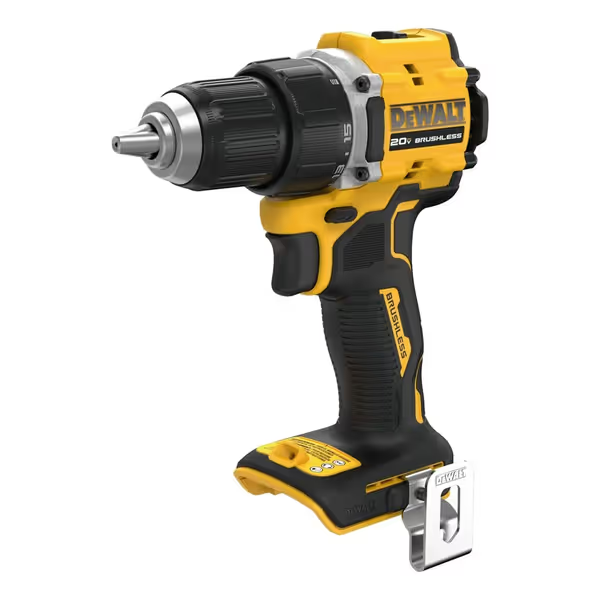
DEWALT DCD794B ATOMIC COMPACT Drill Driver
Compact power rivaling full-size, ideal for tight spaces and overhead work.
$82.99
Form FactorATOMIC COMPACT Series
Form FactorATOMIC COMPACT Series
Pros
Powerful, compact design for superior access.
Lightweight build reduces fatigue on long jobs.
Excellent value for robust, job-ready performance.
Cons
Reverse drive function can be inconsistent.
Battery performance varies among users.
Customers find this cordless drill to be well-made and functional, with great power comparable to full-size Milwaukee tools. They appreciate its compact size and lightweight design, and consider it good value for money. The reverse drive feature receives mixed reviews, with several customers reporting issues where the drill starts turning forward while in reverse. Battery life is also mixed, with some customers reporting great performance while others have have concerns.
Customers find this cordless drill to be well-made and functional, with great power comparable to full-size Milwaukee tools. They appreciate its compact size and lightweight design, and consider it good value for money. The reverse drive feature receives mixed reviews, with several customers reporting issues where the drill starts turning forward while in reverse. Battery life is also mixed, with some customers reporting great performance while others have have concerns.
The Autonomy Breakthrough: Why "Hands-Off" Drilling Translates to Jobsite Uptime
The Drilling Automation for Mars Exploration (DAME) project achieved what every trade pro dreams of: 4 hours of unattended operation at Haughton Crater. Its software detected six distinct fault modes (like voltage sag or auger blockage) and self-corrected. No human oversight. On Earth, this maps to real-world pain points: drills that bog down in pressure-treated lumber, causing chuck slippage and wasted bits. DAME's lesson? True power isn't measured in RPMs but in completed tasks per failure. DEWALT's Atomic line, a compact example of this philosophy, shrinks headroom for cabinet work while maintaining thermal management that prevents cold-weather voltage drop. It's not flashy; it's no-nonsense engineering where the warranty covers downtime from battery mismatches. That's why zero-gravity drilling R&D matters: it forced diagnostics now baked into modern brushless motors, alerting you to impending overload before the clutch slips.
Cost-Per-Minute: The Number Your Supplier Won't Show You
Let's cut through the spin. A $99 drill kit seems cheap until you tally the hidden costs:
- Battery Anxiety: Will that 2.0Ah pack last your deck's 400 lag bolts? NASA's lunar drills use shared power cells (no single-point failure). Your platform should too.
- Cold-Weather Tax: Arctic tests showed 30% runtime loss at -20°F. Consumer drills rarely disclose this, but field data shows some brands lose 50% capacity.
- Warranty Turnaround: If NASA's drill stalled on Mars, engineers had days to fix it. Your supplier typically takes 14 days, costing 3 job opportunities. Compare real-world coverage in our power tool warranty comparison before you commit to a platform.
I've seen trade crews bleed money on "value" kits. One contractor bought a budget line; by week 3, packs idled hot, chargers crawled, and lunchtime drilling died. Tallying callbacks and wasted trips, the actual cost-per-minute was higher than a mid-tier platform. Cheap upfront, expensive in downtime (value shows in charged minutes). That's why lifecycle modeling beats spec sheets. NASA's 60W drill costs millions, but its mission-success rate is near-perfect. Your drill's worth is measured in fewer interruptions per dollar spent.
The Verdict: Budget the Ecosystem, Not the Tool
Space mission tools were born from constraints Earth users now face: unpredictable runtime, thermal limits, and accessory mismatches. Yet too many recommendations focus on peak power, like quoting a rocket's thrust without mentioning fuel efficiency. For a brand-by-brand rundown of batteries, chargers, and tool breadth, see our drill ecosystem comparison. Evidence over hype means demanding:
- Clear thresholds for runtime (e.g., "180 holes in SPF @ 40°F on 2.0Ah")
- Cross-platform battery compatibility (shared cells = less downtime)
- Warranty terms covering battery degradation (not just motor failure)
The DEWALT Atomic Compact exemplifies this: its 2.51-pound frame trades size for sustained 1,650 RPM under load, critical for overhead work where fatigue kills productivity. But the real win? DEWALT's Rapid Chargers turn 15-minute coffee breaks into "charged minute" recovery. That's risk-adjusted value.
Final verdict: Ignore the "strongest drill" headlines. True value is fewer interruptions per dollar spent. Whether NASA's drilling into permafrost or you're building a pergola, the math is identical. Demand tools engineered for sustained output, not empty-spinning boasts. Budget the batteries, not just the tool, and watch your charged minutes climb.
Related Articles