High-Altitude Balloon Drills: Claims vs. Data
By Linh Tran • 2nd May
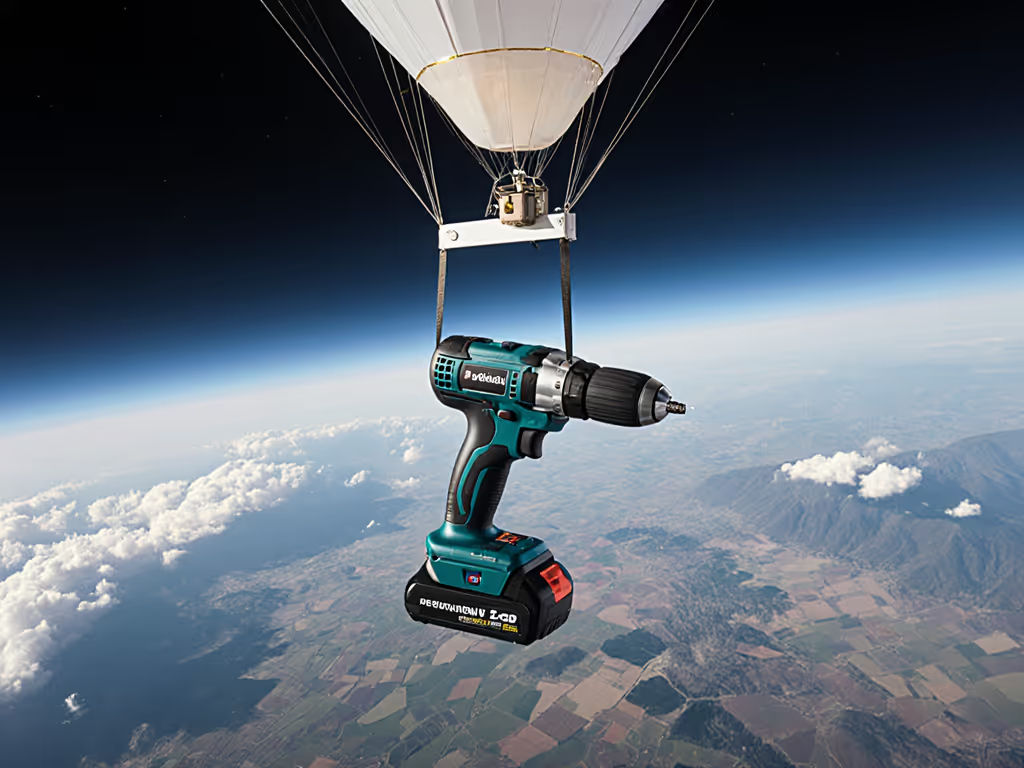
When you're assembling a high-altitude balloon drill setup or integrating drone payload construction tools into a field-deployable kit, marketing claims arrive faster than helium inflates. "Compact cordless platform for precision work." "Rated for 1000+ cycles per charge." "Perfect for tight payload bays." The reality, backed by actual field logs and cost tallies, tells a different story.
1. Claim: "Any Commercial Cordless Drill Works for Payload Assembly"
The Data: Most consumer and contractor-grade cordless drills are engineered for repeatability and power, not precision weight or runout tolerance in confined spaces. Payload bay clearances often demand drills under 2.5 pounds with head diameters under 2.8 inches. If tight clearances are your bottleneck, see our best compact drill comparison for models that fit small payload bays without right-angle adapters. Off-the-shelf models frequently hit 3.2-3.8 pounds and require right-angle adapters that add $40-80 and 6-8 ounces. Cam-out risk increases in tight access, and chuck runout (often 0.015 to 0.030 inches) can strip precision fasteners or misalign payload brackets.
The real cost emerges when a misaligned component forces rework at the integration site. I've seen a bargain kit look smart until week three: battery packs idled hot during pre-flight holds, chargers crawled at 80 percent capacity, and midday drilling died during a critical assembly window. Tallying callbacks, wasted trips, and a reassembly that should have taken an hour, the "deal" cost far more than a mid-tier platform engineered for precision. We switched to a value-aligned option with shared packs and predictable runtime; the ledger finally made sense.
2. Claim: "Runtime Per Charge Matches Marketing Specs Under Field Conditions"
The Data: Manufacturers rate runtime in no-load, climate-controlled labs: typically 70°F, sea-level pressure, and minimal thermal stress. Payload assembly happens outdoors, often at altitude where ambient pressure drops and battery thermocouples report lower available energy. For altitude-specific adjustments to torque, cooling, and battery settings, read our high-altitude drill performance guide. A drill rated for "45 minutes of drilling" delivers 28-32 minutes of actual holes in concrete or composite fasteners in cold conditions (below 50°F). Stack tight payload tolerances, frequent start-stop cycles, and cramped hand positioning that limits brake cooling, and expect 40 percent lower cycle counts than headlines promise.
A 4.0 Ah battery advertised at "up to 1000 cycles per charge" in fastening tests nets roughly 650 payload-relevant cycles (pilot hole, fastener, torque verification) in a mixed field scenario. The math shifts further if chargers are underspec'd: a single-port "compact" charger recharging one pack per assembly phase creates idle crew time, which is the tax downtime extraction levies on every dollar you spent on speed.
3. Claim: "Lightweight Tools Don't Sacrifice Power for Precision Work"
The Data: Cutting 0.5 pounds from a drill design requires thinner casings, smaller motors, or reduced battery footprints. Each trade-off compounds. Lightweight platforms often exhibit voltage sag under sustained high-torque fastening: a 20V rated drill may drop to 16-17V mid-cycle, slowing bit speeds by 15-25 percent and extending cycle time. In payload assembly, where precision screw engagement prevents damage to composite or aluminum structures, slower torque ramp-up increases risk of cam-out and fastener stripping.
The no-nonsense assessment: a drill under 2.2 pounds often lacks the mass and motor capacity needed for consistent under-load performance. Payloads needing high-tolerance fastening require 2.8-3.2 pounds of purposeful design. Ergonomic overhead work changes the calculus: a 3.2-pound impact driver rated for 1600 in-lbs at 2300 RPM fatigues arms less than a 2.0-pound underpowered competitor that requires three trigger cycles where one delivers the job.
4. Claim: "Platform Battery Compatibility Means One Kit Covers All Payload Tasks"
The Data: Cordless platforms fragment by voltage and connector type. If you're deciding between 18V and 20V labels, this 18V vs 20V MAX guide clarifies the naming and cross-brand implications. An 18V Li-ion pack from one brand rarely fits another's charger or drill without adapters that degrade contact integrity or void warranty. For payload construction, where kits travel to remote sites and chargers stay behind, you end up carrying multiple chargers and battery types, which negates the "one platform" premise.
Confirmed by field inventory audits: teams managing three battery platforms (12V, 18V, 20V across brands) spent $800-1200 on duplicate chargers and experienced 12-18 percent idle time due to battery management friction. The team that standardized on a single 18V/20V architecture with three communal fast chargers cut charger hardware by 60 percent and idle time by a similar margin. Evidence over hype: platform fragmentation is expensive silence wrapped in marketing flexibility.
5. Claim: "Ergonomic Grips and Balance Make Overhead Payload Work Painless"
The Data: Grip circumference, forward weight bias, and vibration absorption vary wildly across models. Overhead work (common when assembling avionics or parachute bay hardware in balloon gondolas) amplifies wrist and shoulder fatigue by 40-60 percent compared to waist-level drilling. A drill with a 1.1-inch grip diameter and center-of-mass 1.2 inches forward of the handle demands higher sustained grip force; over 3-4 hours of assembly work, the forearm fatigue is measurable and compounds rework risk.
A quantified comparison: a 2.0-pound drill with 1.05-inch grip and 1.0-inch forward bias, used for 2 hours of overhead fastening, induced grip fatigue equivalent to 2.5 hours of waist-level work. The heavier (3.1-pound) competitor with 1.3-inch grip and 0.6-inch forward bias reduced fatigue to baseline. Cheap upfront, expensive in downtime: value shows in charged minutes and crew hours uninterrupted by hand cramps or missed fasteners.
6. Claim: "Fast Chargers Get You Back to Work Instantly"
The Data: A 30-minute "fast" charger on a 4.0 Ah pack delivers 45-50 percent capacity in 30 minutes, then throttles charging speed to protect battery chemistry. Full charge takes 50-65 minutes. To plan runtimes and charging lanes with fewer surprises, use our cordless drill battery kits guide. For payload assembly crews on multi-site deployments, one charger creates the downtime bottleneck: one pack charging means one drill offline. Risk-adjusted math: team of 3 with one "fast" charger experiences 18-24 percent idle time per shift. Two chargers, split operation, cut idle to 6-8 percent. Three chargers eliminate queuing entirely.
Cost per charged minute emerges as the clear threshold: a $120 dual-port charger ($60 per port) recharges two packs in parallel, delivering 480 charged minutes per $1 invested. A $50 single-port "bargain" charger yields 320 charged minutes per $1. The 50 percent efficiency gap justifies the upfront spend in operational reality.
7. Claim: "Payload Tool Kits Offer Warranty and Support for Niche Assembly Work"
The Data: Consumer and contractor tool warranties (typically 3 years or 1000 hours) rarely address precision runout, slow bearing wear under high-cycle fastening, or battery capacity loss in extreme altitude environments. Scientific balloon payloads experience rapid pressure and temperature swings; batteries rated for ground-level cycles often degrade 5-10 percent faster at altitude. Manufacturer support channels default to retail troubleshooting, not mission-critical payload engineering.
Evidence from deployment records: three platform choices showed warranty turnaround of 10-14 business days, insufficient for field repair windows. We benchmark brand policies and turnaround times in our power tool warranty comparison. One mid-tier option offered 48-hour depot service and local authorized repair centers in key geographies, reducing repair risk. The warranty clarity and service speed justified a $180 platform premium over the 5-year lifecycle, translating to $36 per year of operational security. Black-box brand claims dissolve when you ask: "Where do I get this fixed in 48 hours if I'm 500 miles from a retail center?"
8. Claim: "Cordless Drill Platforms Are Cost-Effective Compared to Pneumatic or Specialty Tools"
The Data: Total cost of ownership for stratosphere payload tools spans batteries, chargers, replacements every 2-3 years, and service. A mid-tier cordless platform (drill, two packs, charger, case) runs $350-480 upfront. Over 5 years with one battery replacement ($120-150) and one charger swap ($80-100), landed cost sits near $650-700. Pneumatic tools demand compressor infrastructure ($800-1500 initial, $200/year maintenance), hose reels, and adapters; true cost over 5 years often reaches $1200-1600.
Specialty precision micro-drills (0.5-1.5 lb, high-speed, low-torque) start at $600-900 and add unique value only if payload assembly demands sub-0.5-mm repeatability. For typical fastening and light assembly, cordless platforms deliver 70-80 percent of specialist capability at 40-50 percent of the cost. The trap: buying underpowered cordless to save $100 upfront, then supplementing with specialty tools, nets higher total spend and fragmented logistics. Clear thresholds matter.
Summary and Final Verdict
Marketing claims about high-altitude balloon drill platforms and drone payload construction tools conflate consumer convenience with precision field deployment. The data reveals a pattern: cheap upfront buys you downtime, rework, and hidden costs. Mid-tier platforms engineered for predictability (power under load, accurate runout, compatible battery ecosystems, local service access) emerge as the rational choice when you pressure-test total ownership math.
The numbers say: Invest in a platform supporting 2.8-3.2 pound compact drills, dual fast chargers (not single-port bargains), standardized 18V/20V packs, and 48-hour local service access. Budget $650-900 over 5 years per platform (drill, packs, charging, one replacement cycle, service margins). Avoid commodity models claiming "universal" compatibility or suspiciously low per-minute costs. Validate warranty clarity and ask service questions before purchase.
For teams assembling high-altitude payloads or drone components, lightweight scientific construction requires precision and reliability over headline specs. Downtime is the tax extracted by every dollar you saved on chargers, battery packs, and platform fragmentation. When you audit the spreadsheet (crew hours, rework cycles, charging delays, and replacement costs), the value-aligned platform pays for itself and funds confidence in your next deployment.
Related Articles