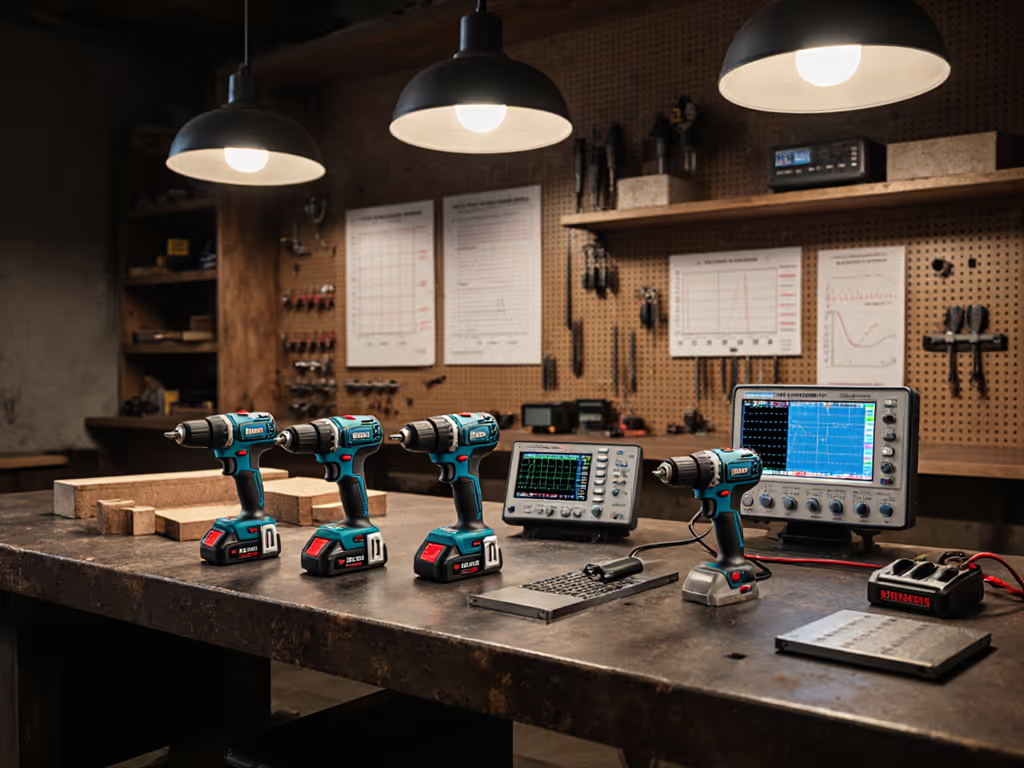
EMI-Shielded Lab Drills: Precision Comparison
By Marco Silva • 27th Mar
Choosing a top cordless drill that delivers consistent accuracy under load requires more than spec sheets (it demands understanding how tool geometry, balance, and motor delivery translate to real-world precision and reduced fatigue). This scientific drill comparison breaks down the gap between marketing claims and jobsite reality, helping you select a drill that performs when it matters most.
Why Precision Matters: The Hidden Cost of the Wrong Tool
When a drill feels unbalanced in your hands or its torque delivery stutters mid-task, fatigue compounds fast. An apprentice I worked with kept rubbing his wrist after ceiling work with a heavy, front-heavy model. We swapped to a shorter head with better balance, added a side handle, and dialed in clutch and cadence. His output rose and pain faded by day's end. That shift taught me a hard lesson: fatigue is a hidden cost; balance beats raw weight every day.
Precision isn't just about hitting the mark; it's about maintaining speed and accuracy across an entire shift without throttling performance or damaging materials. Spec confusion (torque ratings, no-load RPM, brushless claims) rarely predicts how a drill behaves under real load. If those terms trip you up, our drill specifications guide explains what torque, RPM, and chuck size actually mean for real work. This guide cuts through the noise and focuses on people-first metrics: weight distribution, reach, motor stability, and clutch control.
FAQ: What Makes a Drill Truly Precise?
Q: How Do Torque and RPM Translate to Real-World Performance?
Torque (measured in inch-pounds) tells you rotational force; RPM tells you speed. Neither alone predicts how fast you'll drill into concrete or drive screws through hardwood without bogging down or overheating. A drill rated at 1,400 in-lbs might seem powerful, but if its motor sags under sustained load (voltage drop), it will throttle and slow real work. Similarly, a lightweight drill with high RPM might spin fast in air but lack the staying power for dense materials.
Under-load performance, the ability to maintain speed and torque while materials resist, separates precision tools from marketing claims. The Milwaukee M18 FUEL 2904-20 delivers 1,400 inch-pounds and 2,100 RPM at 4.91 lbs, designed for masonry and heavy construction. That compact weight paired with stable motor delivery matters more than the raw number. Conversely, the Skil PWRCORE 20V offers 400 inch-pounds and 1,700 RPM at just 2.23 lbs, ideal for light DIY and furniture assembly, where precision means avoiding over-torquing and splitting wood.
The key: reach matters more than specs. A lighter, well-balanced drill that you can control overhead for a full shift will outperform a powerful tool that exhausts you by noon.
Q: What's the Difference Between 18V, 20V MAX, and 24V Platforms?
Voltage indicates the battery's nominal power, but "MAX" labeling (like DeWalt's 20V MAX) is marketing, and it doesn't mean the tool is universally stronger. Get the full breakdown in our 18V vs 20V MAX comparison. Each ecosystem has trade-offs:
- 18V platforms (Milwaukee M18, Ryobi ONE+, Bosch, Makita LXT): mature, wide tool selection, generally lighter and more maneuverable. Ryobi 18V ONE+ offers 850 inch-pounds at 2.7 lbs, good for mid-level DIY; Milwaukee's heavier offering (4.91 lbs) caters to pro masonry work.
- 20V MAX systems (DeWalt, Ryobi): bridge pricing and power. DeWalt 20V MAX XR brings 1,050 watts (roughly 1,050 in-lbs equivalent) at 4.1 lbs for concrete and heavy driving.
- 24V brushless (FLEX): higher torque (1,400 in-lbs) but heavier (~6 lbs), suited for demanding joists and studs where raw power justifies fatigue cost.
Don't chase voltage alone. Instead, match voltage to your most frequent task. If you're hanging shelves and light cabinet work, an 18V lightweight setup saves wrist strain. If you're drilling concrete footings daily, a 20V or 24V platform with a side handle justifies the extra weight.
Q: How Does Motor Stability Under Load Affect Accuracy?
A brushless motor with electronic commutation maintains torque more evenly than older brush designs, reducing speed sag and thermal throttling. For a deeper dive into efficiency and lifespan, see brushless vs brushed drills. However, even brushless motors drop voltage when current spikes (say, when you hit a knot or hard aggregate). A drill that "feels" responsive has motor firmware that compensates quickly and a battery management system that sustains voltage under surge.
The Milwaukee M18 FUEL line uses fuel cell technology to maintain voltage consistency. The Bosch 18V Brushless includes a precision-tuned clutch that stops the motor when resistance peaks, preventing strip-outs and maintaining accuracy in finish work like drywall and plywood. These refinements cost more upfront but reduce rework and material waste, a clear TCO win for precision-sensitive tasks.
Q: What Role Does Weight and Balance Play in Fatigue and Accuracy?
Weight matters, but balance matters more. A 3-lb drill with its mass concentrated at the chuck creates uneven arm fatigue and wrist strain in overhead work. A 4-lb drill with the battery pack positioned for neutral balance, plus a compact drill head and integrated side handle, distributes load to your core and reduces wrist stress.
Compare the Skil PWRCORE 20V (2.23 lbs, designed compact for accessibility) to the FLEX 24V Brushless (~6 lbs but heavier torque). The Skil excels in cabinet access and furniture assembly; the FLEX dominates joist and stud driving where sustained power compensates for extra weight. Neither is "better"; they're right-sized for different pain points. Stress the setup, not just the spec: pair a mid-weight drill with a side handle, and you cut fatigue dramatically while improving control and precision.
Q: How Do Clutch Settings and Trigger Modulation Prevent Material Damage?
A clutch disengages the chuck when preset torque is reached, preventing over-driving screws and stripping fasteners. Learn proper setup and torque selection in our drill clutch mechanics guide. Sensitive clutches (like Bosch's anti-strip feature) allow finer adjustments, critical for soft materials like plywood and drywall. Trigger modulation, the ability to feather speed smoothly rather than jumping from slow to full, lets you apply precise pressure during startup and in tight spaces.
Neither feature appears in budget or ultra-compact models. If your work includes finish carpentry, cabinetry, or any task where material surface matters, invest in a drill with variable trigger and a multi-setting clutch. The Milwaukee M18 FUEL includes an autostop control suited to masonry; the Ryobi 18V ONE+ uses an integrated LED and ergonomic grip for visual cues in tight spaces. These features reduce kickback and improve confidence, measurable safety gains.
Q: How Do I Choose Between a Hammer Drill and a Standard Drill Driver?
A hammer drill adds rapid axial impacts, helping break through concrete and masonry. Standard drills rely on rotational force alone and are lighter, faster for wood, and gentler on materials. For DIY and general construction, a standard drill is the safer starting choice.
The Milwaukee M18 FUEL 2904-20 and DeWalt 20V MAX XR are hammer models, heavier and sized for professional crews. The Ryobi 18V ONE+ and Skil PWRCORE are standard drill drivers, lighter and ideal for framing, decking, and remodels. Match the mode to your work frequency, not to a single job.
Precision Comparison: Top Models by Use Case
| Model | Voltage | Torque | Weight | Best For | Key Precision Features |
|---|---|---|---|---|---|
| Milwaukee M18 FUEL 2904-20 | 18V | 1,400 in-lbs | 4.91 lbs | Masonry, heavy construction | Autostop, side handle, consistent motor delivery |
| DeWalt 20V MAX XR | 20V | 1,050 watts | 4.1 lbs | Concrete, heavy driving | High-torque platform, proven under-load stability |
| Ryobi 18V ONE+ HP | 18V | 850 in-lbs | 2.7 lbs | Shelving, mid-level DIY, drywall | Ergonomic grip, integrated LED, light enough for overhead |
| Skil PWRCORE 20V | 20V | 400 in-lbs | 2.23 lbs | Light DIY, furniture, cabinet access | Compact head, fast charging, minimal fatigue for delicate tasks |
| Bosch 18V Brushless | 18V | Precision-tuned | 3.0 lbs | Drywall, plywood, finish work | Sensitive anti-strip clutch, responsive trigger, visual control |
| FLEX 24V Brushless | 24V | 1,400 in-lbs | ~6 lbs | Joists, studs, heavy-duty tasks | High torque, durable for sustained driving |
The Setup Matters as Much as the Drill
A precision drill alone won't guarantee accuracy. Pair it with the right accessories:
- Side handle: Distributes grip force, reduces torque reaction, critical for hammer drills and overhead work.
- LED work light: Clarifies your target, especially in tight cabinets or dimly lit spaces.
- Compact or right-angle head: Unlocks access to confined spaces (inside cabinets, between joists) without sacrificing control.
- Bit quality and retention: A precise chuck with minimal runout prevents wander and reduces tear-out. Invest in sharp bits sized to your material.
- Clutch tuning: Review your drill's clutch scale and test on scrap before committing to fastening sequence.
These details, often overlooked, are where real precision lives. An ergonomic setup reduces fatigue, which preserves accuracy over hours, far more than raw power ever will.
Moving Forward: Select by Task Frequency, Not by Specifications Alone
Identify your three most common drilling tasks over the next 2 years: type of material, bit size, depth, and frequency per week. Cross-reference that against the table above, prioritizing weight and balance for tasks you'll repeat daily and endurance. If overhead work dominates, sacrifice torque for a sub-3-lb model; if concrete is constant, accept extra weight for motor stability.
Test a shortlisted model in your hand before buying. Reach matters more than specs: can you access your tight spaces? Does the grip feel natural? Can you comfortably hold it overhead for 30 seconds without fatigue? Does the trigger modulate smoothly? These sensory checks predict real-world success far better than YouTube reviews or magazine scores.
Once you've chosen, commit to a single platform for batteries and chargers. A matched ecosystem (consistent voltage, connectors, and charging infrastructure) reduces downtime, training friction for helpers, and total cost of ownership. Safety-forward tool selection isn't just about the drill; it's about the entire workflow that keeps fatigue low and quality high across your whole shift.
Related Articles